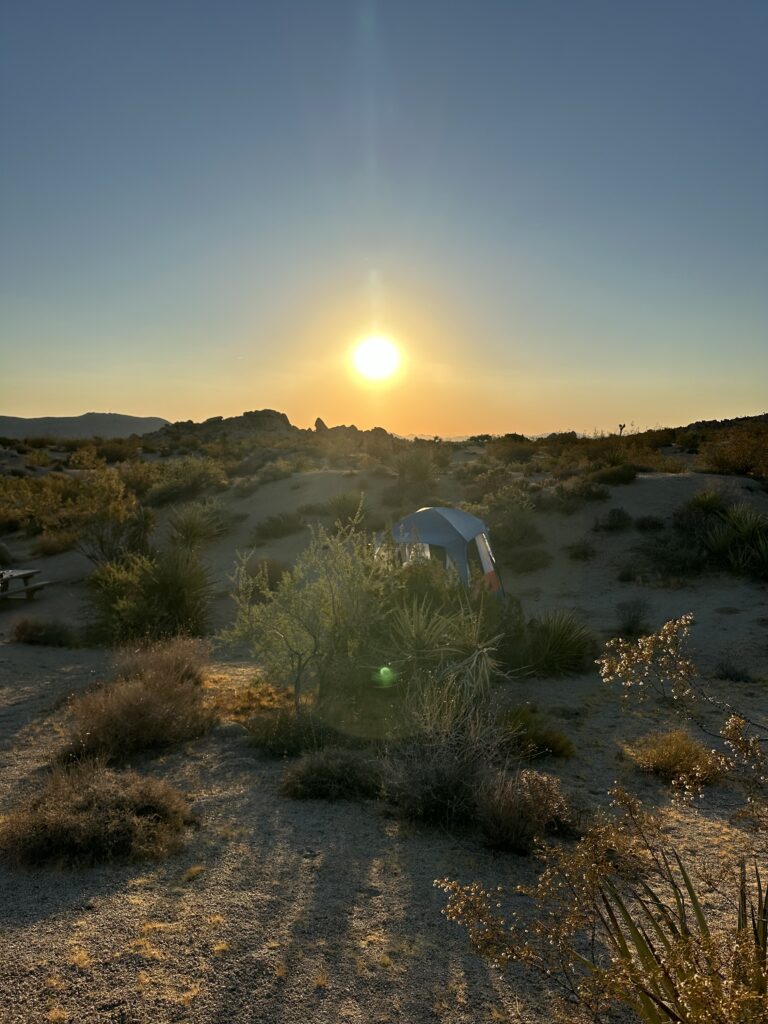
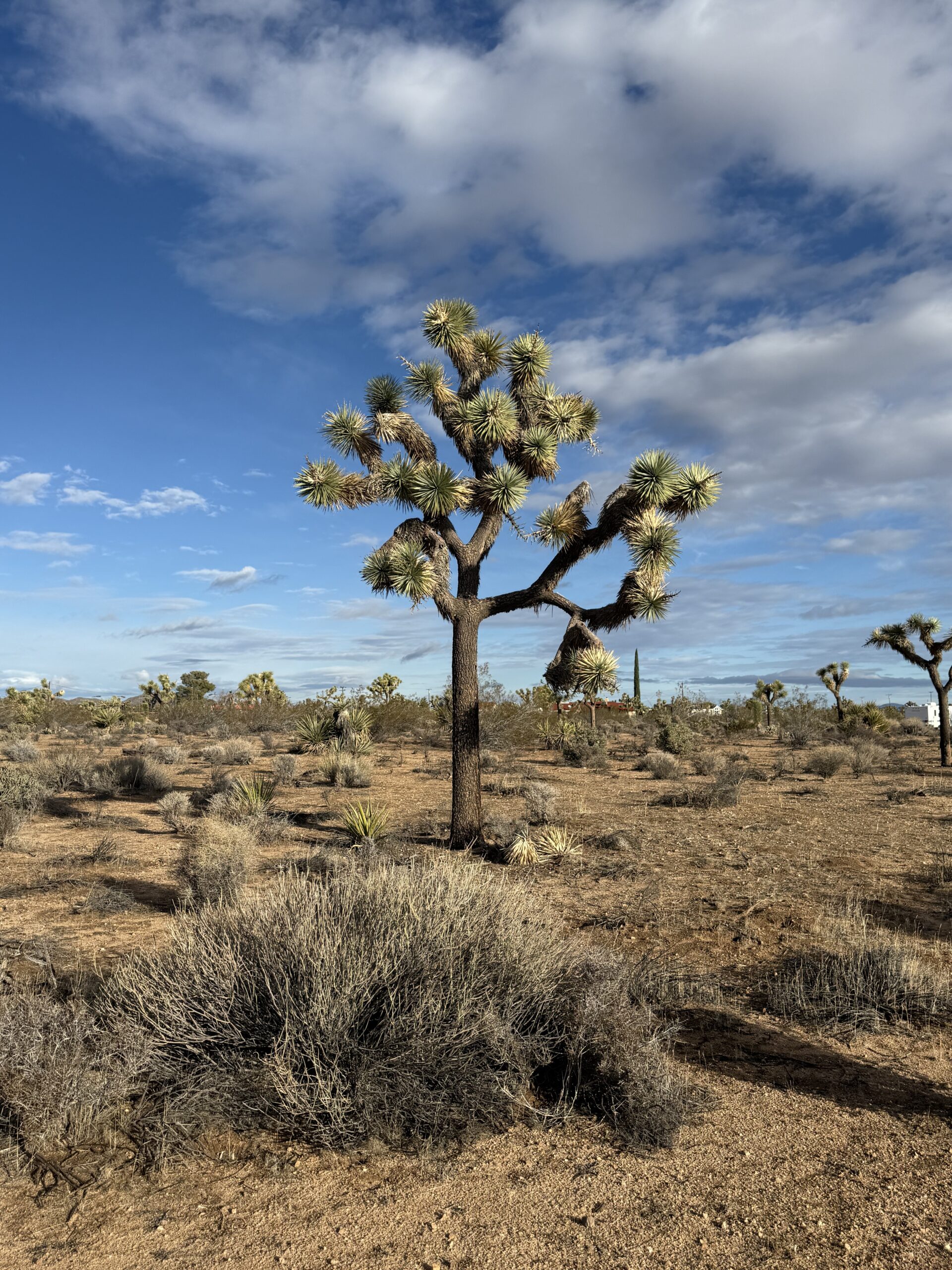
Joshua Tree sits at an elevation of 2,767 feet in the Mojave Desert of Southern California. Despite its population of just around 6,500, Joshua Tree holds the dubious honor of increasing popularity for tourism, mostly due to its positioning as one of the main entry points to Joshua Tree National Park. The terrain is truly beautiful: vast expanses of the namesake Joshua trees with their limbs outstretched and crooked, surrounded by mountain ranges on all sides. The dry climate fosters the growth of desert cacti, like cholla and pricklypear, while the seasonal rains bring colorful wildflower blooms, such as the bright yellow brittlebush. Though not often seen by the casual visitor, Joshua Tree is also home to a variety of wildlife from rattlesnakes to bobcats, scorpions to coyotes, desert tortoises to bighorn sheep.
The high desert climate offers searing hot summers and cold violently windy winters. While harsh conditions prevail for much of the year, Joshua Tree still seems to get more popular as time goes on. Deserts were long thought of as lifeless hellscapes where very few would go willingly, least of all for leisure or relaxation. Thanks, in part, to a handful of 20th century desert lovers—such as writers Mary Hunter Austin, Minerva Hoyt, Edward Abbey—people began to see the desert for what it really is: a unique ecosystem brimming with life and it’s own kind of beauty. Surely, it was no coincidence that this mid-twentieth century rise in popularity coincided with the advent of indoor air conditioning. And so, the people came to the high desert and the highway followed shorty after (now designated as SR62). Businesses came and went and new ones spring up with regularity. Joshua Tree has attracted more and more tourists with each passing year, most notably since 2020. While that may be great for local businesses and real estate developers, there is a definite downside to this popularity.
There has been an ever increasing number of vacation rental homes in the area and most of these are not family homes being rented out when the residents are out of town. This vacation rental business has become an industry. People looking to make a buck are buying up multiple homes in order to rent them out at ridiculously high prices. Issues of displacement and gentrification aside, this monied assault on the community has led to an ever increasing number of obnoxious and disrespectful visitors to the area. It is strange that so many people appear to be drawn to the quiet desert yet do not recognize the sanctity of the desert quiet. The desert is a place for solitude, a place for hushed tranquility, yet more and more, it is attracting groups of loud mouthed, edm blasting morons.
The once slow-paced pizza place where you could drop in and grab some dinner to go is now, even in the off seasons, jam-packed with tourists spilling out into the parking lot. Joshua Tree, for me, was always a place to go to get away from people—the crowds and the lines. Yet, people and crowds and lines are now a common sight all over the town. The coffee shops are littered with young “professionals” on laptops—in a place where people would traditionally go to unplug, literally and in spirit. A town needs people in order to thrive but some people, like myself, worry about those people changing the character of a town, whatever that may mean. Time marches ahead and places do change, and yet there is something unsettling about a coffee shop filled with tech bros in a small high desert community or a freshly washed BMW driving through the dusty roads of the national park. Joshua Tree certainly doesn’t need any more overpriced cowboy hat stores or yoga studios.
While, in theory, it is great that more and more people are finding themselves drawn to the desert, it is unfortunate that it is often at the expense of the actual environment. The 2018-2019 government shutdown led to some truly garbage behavior from people in Joshua Tree National Park. Like literal garbage, for starters; people were leaving their trash all over the park, not caring that there would be no one there to pick up after them. There was graffiti, vandalism and, most insulting of all, the willful destruction of Joshua trees. Even in normal times, I see tagging on large rock structures, litter on the side of the roadways and people climbing on the Joshua Trees. On my last camping trip in the park, some moron was blasting dance music at his campground, which could be heard throughout the surrounding area.
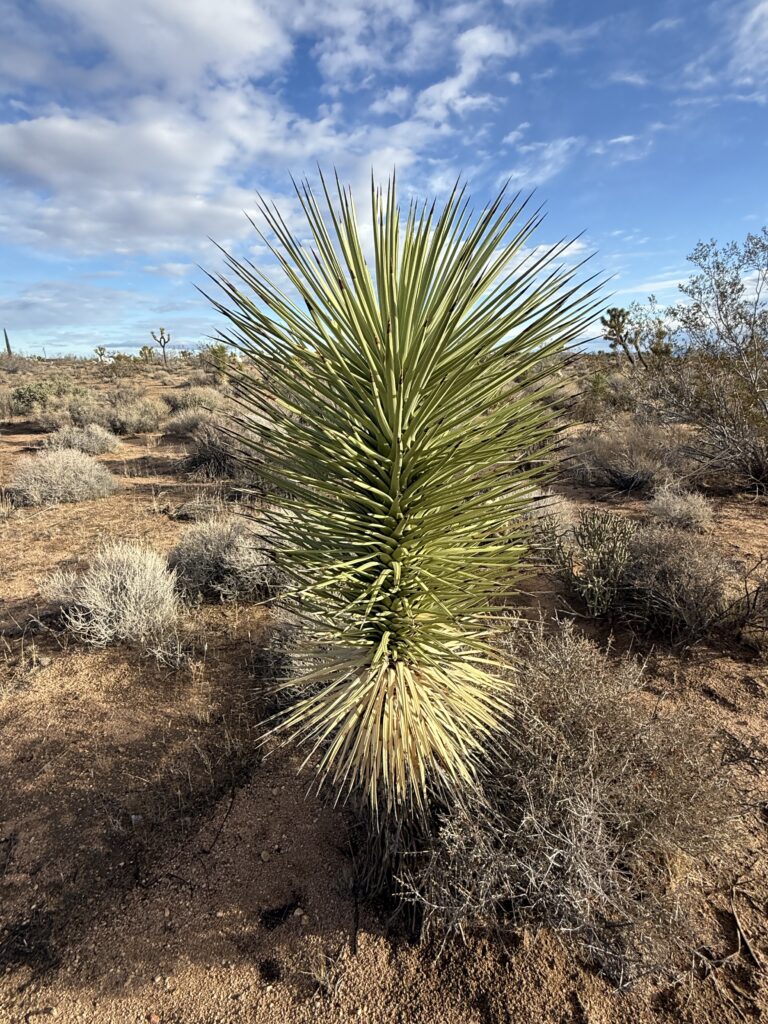
But sometimes the desert fights back and helps to remove these people from this earth. There have been a number of deaths in the park over the years and they tend to be the result of ignorance and inexperience. As internet connectivity spreads its wicked reach to more and more remote areas, most of Joshua Tree National Park is a dead zone for cell phone and internet use. That means no checking your GPS, calling 911 or posting selfies to your social media in the park. It often seems that some people see the well curated internet photos of smiling visitors in their novelty hiking hats and assume that the park is a kind of desert amusement park, a nice backdrop for your latest profile pic. But the desert is real wilderness. Many people get lost there, and those who do not come prepared with proper clothing and supplies can, and do, die.
But just as someone sitting in traffic, complains of the traffic, I am there too. I am not a local. I am an interloper, a tourist, a partaker in the scourge of vacation rentals. Yet, there is a certain quality (or lack thereof) of visitor that I do increasingly see in Joshua Tree. I worry about the place becoming the next Sedona: overpriced and stripped of character. There is a common trend in the modern world, brought upon by social media, where people appear to be more interested in showing that they have been to a place than they are in actually being in the place. If no one sees that you have been somewhere, did you actually go? The desert inspires in me certain thoughts. Thoughts of life and death and impermanence and change. These thoughts remind me that nothing lasts forever: not overpriced crystal shops, nor social media trends. I’m comforted by the fact that long after we are gone, and we will all be gone, the desert will remain.
I would like to believe that Joshua Tree holds a roughness, an edge that can not be Sedona-fied. Each year, hikers perish in the park. The weather and the terrain serve as harsh reminders of the indifference of nature. A harsh reminder of our own insignificance, as the turkey vultures expectantly glide above us: another easy meal from the big city. One wrong turn on a hike without a map may prove fatal. Your Tesla parked two miles away can’t save you now. We, as a species, have attempted to conquer the desert but it feels unconquerable. The forces of nature are just biding their time as we strive to make the inhospitable hospitable. We can pump out all of the air conditioning that we can power but the brutal winds and the searing heat will endure. The desert is scary, vast and beautiful and nothing we do can change that for long.
And so I will continue to spend as much time as I can in the high desert. I will drive past the tourists and the meth-inspired locals, find my small patch of land, light a fire and forget all of the daily nonsense: a much needed reminder of why I am here. I will watch the sky as it turns from pale blue to pink to black. I will open a beer, light a cigarette and enjoy the seemingly countless shining stars above me. I will hear the coyotes howl in the distance and all will be well in the world.